Forgotten Women: Pioneers Who Built the Modern World
TL;DR:
- Women like Ada Lovelace, Grace Hopper, Rosalind Franklin, and Gladys West built the critical infrastructure of the modern world — and history almost erased them entirely.
- The "Matilda Effect" isn't an accident: it's an active system of intellectual dispossession that operated for centuries.
- Women's burden didn't change over time — it accumulated. Domestic work wasn't redistributed when women entered the workforce. It was simply added on top.
Today is March 8th. And I don't want to write a post that celebrates how far we've come so we can feel good for ten minutes before going back to the same reality.
I want to talk about what actually happened. About the women who built the modern world with their own hands and their own minds — and how society, designed by men and for men, took that work, registered it under a colleague's name, a boss's name, a husband's name, and moved on like nothing happened.
Because that's exactly what occurred. Not once. Systematically. For centuries.
The Matilda Effect: erasing women is a policy
In 1993, historian Margaret W. Rossiter named something that had been happening ever since women started doing science: the Matilda Effect. The social and institutional bias that prevents women from receiving credit for their own discoveries.
It's not carelessness. It's not forgetting. It's a structure.
Trotula of Salerno, a 12th-century physician, wrote foundational treatises on gynecology and obstetrics that were used for hundreds of years. After her death, her authorship was questioned and attributed to men. The conclusion was breathtaking in its audacity: a woman could not possibly possess that level of medical erudition. So they simply… erased her.
Nettie Stevens discovered that sex in organisms is determined by X and Y chromosomes. Credit went to her mentor, Thomas Hunt Morgan.
Gerty Cori, the first woman to win the Nobel Prize in Medicine, worked for years as her own husband's assistant because universities refused to hire her as a professor — even though the research was as much hers as his.
Do you see the pattern? It's not that women weren't there. The system was designed to make sure they wouldn't appear.
The double burden no one talks about
I want to pause here, because this is the point that matters most to me today.
When we talk about how women's situation "improved" over time, there's something that's rarely said: women's work didn't change. It accumulated.
Centuries passed, and women were gradually "permitted" to enter the workforce, academia, and technology. But that entry didn't come with a redistribution of domestic work. No. It came on top.
The pioneers in this post didn't just have to be extraordinarily brilliant to be taken seriously in hostile environments. They also kept being the ones who cooked, cleaned, raised children, cared for the sick, managed households. The world told them: "You want to do science? Fine. But you still do everything else."
And they did. With all of that on top.
That's not progress. That's accumulation.
Rosalind Franklin: they stole her Nobel
Rosalind Franklin was an expert in X-ray crystallography. In the 1950s, she produced "Photo 51" — an X-ray diffraction image that clearly revealed the helical structure of DNA.
That image was the result of years of meticulous work in an environment where her male colleagues treated her as a technical assistant rather than the elite scientist she was.
Without her consent, her colleague Maurice Wilkins showed that image to James Watson and Francis Crick. They used that information to build the double helix model. In 1962, Watson, Crick, and Wilkins received the Nobel Prize. Franklin had died four years earlier, at 37, from ovarian cancer — possibly aggravated by her constant exposure to X-rays during her research.
She never knew that her data had been the fundamental pillar of the most important biological discovery of the 20th century.
Without Rosalind Franklin's work, there would be no genomic medicine and no mRNA vaccines that enabled us to face global pandemics.
Lise Meitner: the mother of nuclear energy who didn't get the Nobel
Lise Meitner worked for decades with chemist Otto Hahn researching radioactivity. Their collaboration was symbiotic: he ran the chemical experiments, she provided the theoretical physical interpretation.
In 1938, Nazism forced her to flee Germany. Sheltered in Sweden under extreme hardship, she continued guiding Hahn by correspondence. It was she who understood that bombarding uranium with neutrons wasn't creating heavier transuranium elements — it was splitting the atomic nucleus in two, releasing massive energy. She coined the term "nuclear fission" and performed the mathematical calculations to explain it.
In 1944, the Nobel Prize in Chemistry went to Otto Hahn. Alone. The committee ignored Meitner.
Albert Einstein called her "our Marie Curie." The scientific community today recognizes this as one of the greatest injustices in Nobel history. For the record: Meitner refused to work on the Manhattan Project. She prioritized ethics over military glory. How many of those who received military honors did the same?
Grace Hopper: without her, programming would be a secret language
Grace Murray Hopper, Rear Admiral in the U.S. Navy, proposed something radical for the time: that humans shouldn't communicate with machines in binary code, but in a language close to English.
In 1952 she developed the first compiler, the A-0 system — a tool that automatically translated natural language instructions into machine code. Her vision gave birth to COBOL, the programming language that still today underpins the vast majority of the world's banking transactions.
Without Grace Hopper, programming would be a cryptic task reserved for a mathematical elite. The massive expansion of technology into everyday life would not have been possible. No startups, no apps, no commercial internet as we know it.
The next time you use any software, remember Grace.
The ENIAC programmers: "refrigerator models"
During World War II, the term "computer" was originally a job title for people who performed complex calculations by hand. And those people were, for the most part, women.
In 1942, the U.S. Army recruited hundreds of female mathematicians to calculate ballistics tables. Six of them — Betty Snyder Holberton, Jean Jennings Bartik, Kathleen McNulty, Marlyn Wescoff, Ruth Lichterman, and Frances Bilas Spence — were selected to program the ENIAC, the first electronic digital computer.
They weren't allowed to see the hardware initially. They had to learn by studying circuit diagrams and wiring schematics. Programming the ENIAC meant physically connecting thousands of cables.
When the ENIAC was presented to the press in 1946, the women were omitted from the official credits.
For decades, historians viewing archival photos assumed the women appearing next to the machine were "refrigerator models" — placed there to improve the aesthetics of the photograph. They didn't understand, or didn't want to understand, that those women were the only ones who actually knew how to make the system work.
Gladys West: 42 years building GPS in anonymity
Gladys West worked for 42 years as a mathematician at the Naval Surface Warfare Center. Her job: processing satellite data to create a precise mathematical model of the Earth's shape — the geoid.
The Earth is not a perfect sphere. Variations in gravity and tides cause surface irregularities. West programmed an IBM 7030 Stretch computer to perform billions of calculations that accounted for those variations with centimeter-level precision. Her algorithms are the critical component that allows a GPS receiver to know exactly where you are on the planet.
Her contribution was publicly recognized in 2018 — when a member of her sorority read a biography she had written for an alumni event.
42 years. Anonymous.
Every time you use Google Maps, it's Gladys West guiding you.
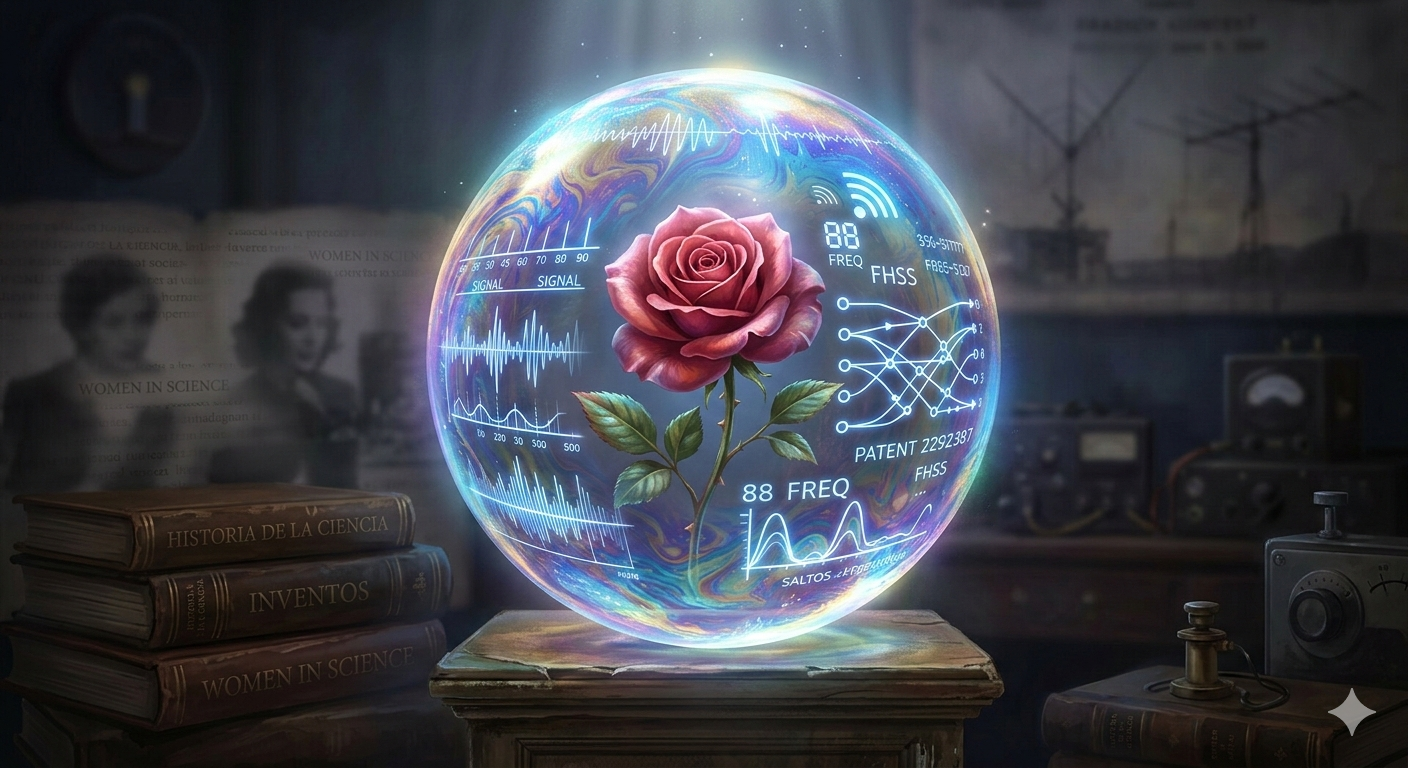
Hedy Lamarr: the actress who invented WiFi
Did you know that the technical foundation of WiFi, Bluetooth, and CDMA mobile telephony was invented by a Hollywood actress fleeing Nazism?
Hedy Lamarr, an Austrian-born actress, during World War II devised a "frequency hopping" system to prevent Allied torpedoes from being intercepted. Inspired by player pianos, she designed with composer George Antheil a method for radio signals to hop between 88 different frequencies pseudo-randomly.
They patented the invention in 1941. The U.S. Navy rejected it as "too complex."
Decades later, with the patent expired, that idea became the foundation of spread spectrum technology — the technology that today connects billions of devices worldwide.
Lamarr never received financial compensation. She died in 2000. In 1997, the Electronic Frontier Foundation gave her a belated recognition. She was 82 years old.
Karen Spärck Jones: the woman behind Google
In 1972, Karen Spärck Jones introduced the concept of "inverse document frequency" (IDF) — a statistical technique that allows a computer to determine the relevance of a word in a text by comparing how common it is in a larger document collection.
Sound familiar? It's the foundation of how search engines work. Including Google. It's also fundamental to how today's language models like GPT or Claude process and "understand" the importance of terms.
Her motto was: "computing is too important to be left to men."
She was right. And yet the world tried to leave it to the men anyway.
Women leaders today: the work keeps accumulating
The current landscape shows real advances. There are women leading the most influential AI organizations:
- Fei-Fei Li (Stanford / World Labs) — creator of ImageNet, now developing "spatial intelligence" with large 3D world models
- Mira Murati (Thinking Machines Lab) — former CTO of OpenAI, now building her own lab focused on transparent, collaborative AI
- Daniela Amodei (Anthropic) — leading Claude's development with a focus on safety and alignment
- Timnit Gebru (DAIR Institute) — her research on racial and gender bias in AI systems forced the industry to confront its responsibilities
- Joy Buolamwini (Algorithmic Justice League) — demonstrated that facial recognition algorithms have up to a 35% error rate for dark-skinned women vs less than 1% for light-skinned men
But let's be clear: the fact that there are women leaders in 2026 doesn't mean the problem is solved. It means some were able to push through the barriers. The barriers are still there.
And the domestic workload remains disproportionately female. Care work remains invisible. The "permission" to do science, technology, or leadership remains a conditional privilege.
The burden didn't change. It accumulated.
What we wouldn't have without them
To make clear what's at stake when we make women's work invisible:
- Without Gladys West and Hedy Lamarr: GPS and WiFi as we know them wouldn't exist
- Without Grace Hopper: programming would be a secret language for mathematical elites; modern software wouldn't exist
- Without Radia Perlman (inventor of the STP protocol that stabilizes Ethernet networks): the Internet would collapse under today's data volume
- Without Rosalind Franklin: there would be no genomic medicine and no mRNA vaccines
- Without Karen Spärck Jones: Google wouldn't exist as we know it; neither would LLMs
The infrastructure of the modern world is, in a fundamental part, the work of women that history almost never named.
To close: let's name them
March 8th is not a day to celebrate how good things are. It's a day to name what happened, understand how it keeps happening, and commit to making sure credit goes where it belongs.
Naming matters. History is built from the names we choose to remember.
So today: Ada Lovelace. Rosalind Franklin. Lise Meitner. Grace Hopper. Hedy Lamarr. Gladys West. Radia Perlman. Karen Spärck Jones. Betty Snyder Holberton. Jean Jennings Bartik. Kathleen McNulty. Marlyn Wescoff. Ruth Lichterman. Frances Bilas Spence. Nettie Stevens. Gerty Cori. Marthe Gautier. Marian Diamond. Trotula of Salerno.
And all the ones we haven't rescued from oblivion yet.
References
- The Matilda Effect — Institute of Biomedicine of Valencia
- The 'Matilda Effect': women whose work was attributed to men
- Gladys West — Britannica
- Women Pioneers in Artificial Intelligence — IIC
- Pioneer Women Who Defined Information Technology
- 10 top women in AI in 2025 — DailyAI
- Absence of women in AI reproduces sexism — UN News
- Women Pioneers of Computer Programming — Women's History Museum
Cris Fernandez — Making tech accessible and fun for everyone 💃 Because history is written by those who name things. Let's start naming things right.