NVIDIA RTX Spark: Agentic Local AI Comes to Laptops
TL;DR:
- At Computex 2026, NVIDIA unveiled the RTX Spark superchip: a Grace Arm CPU, a Blackwell GPU with up to 6,144 CUDA cores, and up to 128 GB of unified memory in a single package, capable of running models with up to 120 billion parameters locally.
- It's not just hardware. It's a strategic pivot toward an agentic Windows, where autonomous agents work on your machine —even when you're away— without shipping your data to the cloud.
- The move redefines personal computing and challenges Apple Silicon, but it carries premium pricing (USD 1,799 to 4,000), new security risks, and a silicon geopolitics worth watching closely.
On January 21, 2026, NVIDIA did something that looked like a retreat: it discontinued ChatRTX, the local chatbot demo it had launched two years earlier. A few months later, at Computex 2026, it became clear this was not a withdrawal but a repositioning. The company didn't abandon local inference — it moved it from a standalone app into the very root of the operating system.
This article is a technical analysis of the NVIDIA RTX Spark superchip, based on NVIDIA's own documentation, reporting from the Financial Times and Tom's Hardware, and projections from Morgan Stanley. The goal is concrete: to understand where this technology is heading, who is involved, and —above all— what changes in the daily life of anyone who uses a computer to work.
From ChatRTX to an agentic operating system
NVIDIA's "edge" strategy (computing that happens on your device rather than in a data center) reveals a calculated transition. In early 2024 it launched "Chat with RTX," a free retrieval-augmented generation (RAG) demo that connected a local chatbot to your personal files. It required at least 8 GB of VRAM on a GeForce RTX 30-series or newer, and over time it added support for models like Google Gemma, ChatGLM3, CLIP-based vision, and Whisper speech recognition.
On January 21, 2026, NVIDIA officially ended ChatRTX maintenance. Far from a commercial failure, the decision was a pivot: the expertise accumulated with TensorRT-LLM and LlamaIndex moved from a companion app into the Windows infrastructure itself. The engineering alliance between NVIDIA and Microsoft turned desktop AI from a "separate chat" into a native agentic platform.
What does "agentic" mean in practice? That the silicon is optimized to run persistent autonomous agents that go beyond the traditional mouse-and-keyboard input model. With RTX Spark support, those agents can operate without constant supervision: they interact with Windows applications, modify system files, and evaluate the quality of their own work in the background — even while you're not in front of the machine. The computer stops being a manual execution tool and becomes what NVIDIA calls an autonomous "teammate."
What the RTX Spark superchip is
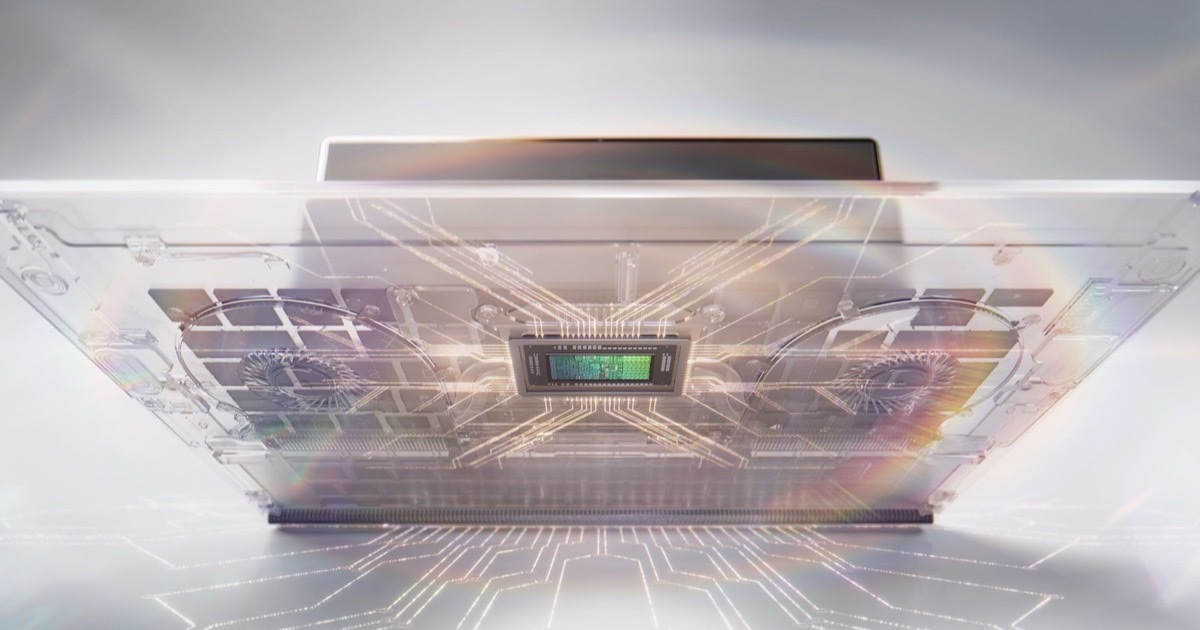
The RTX Spark is a hybrid SoC (system-on-chip) that consolidates three critical components into a single integrated package. Developed with MediaTek for the Arm CPU design, it's manufactured on TSMC's 3-nanometer node with advanced 2.5D packaging.
The technical key lies in how those components communicate. The NVLink-C2C interconnect delivers 600 GB/s of bidirectional bandwidth between the Grace Arm CPU (up to 20 cores), the Blackwell GPU (up to 6,144 CUDA cores), and a unified LPDDR5X-9400 memory pool of up to 128 GB. By eliminating the copy layer between CPU and GPU that traditional PCIe buses impose, the Spark mitigates the main bottleneck in a language model's token generation: memory-channel latency. In practice, this allows it to run models with up to 120 billion parameters at context lengths of up to one million tokens, locally.
NVIDIA introduced two variants with very different profiles:
| Metric | RTX Spark N1 (upper-mid range) | RTX Spark N1X (enthusiast) |
|---|---|---|
| Grace Arm CPU cores | 12 Grace cores | 20 cores (10× Cortex-X925 + 10× Cortex-A725) |
| GPU | Blackwell RTX | Blackwell RTX (6,144 CUDA cores) |
| Discrete GPU equivalent | GeForce RTX 5050 Laptop | Desktop GeForce RTX 5070 |
| Max unified memory | Up to 64 GB LPDDR5X | Up to 128 GB LPDDR5X-9400 |
| Memory bandwidth | ~150–200 GB/s (estimated) | Up to 300 GB/s |
| AI compute | ~0.5 PFLOPS FP4 (estimated) | 1.0 PFLOPS FP4 |
| Laptop base price | From USD 1,799 | From USD 2,899 |
The most striking figure: the N1X's 6,144 CUDA cores exceed the physical configuration of the laptop GeForce RTX 5070 Ti (5,888 cores) and match the desktop RTX 5070. In an ultrathin chassis, that enables rendering 3D scenes over 90 GB, processing 12K video in 4:2:2 in real time, and running AAA games at 1440p above 100 fps — all underpinned by Blackwell Max-Q, which improves battery life by up to 40%.
The real moat: CUDA and the software
The RTX Spark's competitive advantage isn't just raw power — it's the maturity of its software stack. Recent evidence backs this up: Qualcomm's Snapdragon X series had efficient silicon but failed to capture meaningful share in AI development because its software was immature, forcing developers to rewrite code through DirectML or QNN.
The Spark, by contrast, natively inherits the entire CUDA ecosystem. A machine learning engineer can build, test, and deploy local models with PyTorch (CUDA backend), TensorRT-LLM, or llama.cpp directly on a laptop, with no code changes. On top of that sit several new components that enable secure on-device agent deployment:
- Microsoft eXecution Containers (MXC): Windows kernel-level security primitives that create isolation environments for agents. Their job is to prevent an autonomous agent operating on the file system from becoming an attack vector via prompt injection.
- NVIDIA OpenShell: runs on top of MXC and provides policy management, local inference routing, and dynamic obfuscation of personally identifiable information (PII) to prevent leaks to third-party APIs.
- NVIDIA NemoClaw and Hermes Agent: tooling to deploy agents through WSL and specialized containers (WSL-C), removing manual resource management.
- "Computer use" models like H Company's Holo 3.1: optimized by NVIDIA to double their execution speed on Blackwell. They let an agent "see" the screen, process the GUI in real time, and take control of peripherals. Their quantization cuts memory requirements by 35% versus FP8 precision.
- Windows AI APIs and Phi-Silica: Windows automatically routes local inference to the GPU via TensorRT, with the small Phi-Silica model (3.3 billion parameters) as the native base for summarization, code generation, and drafting.
This is the same pattern we documented in our analysis of AI agents: the difference between a demo and a product is the control infrastructure. And control brings risks that shouldn't be downplayed, as we detailed in the security of code-writing agents.
Who's involved: the geopolitics of silicon
NVIDIA's entry into laptop SoC design adds a layer of complexity to the global board. Architecturally, the industry is in a transition where Intel and AMD's x86 is being challenged by Arm's thermal efficiency. NVIDIA's move stands out for its duality: securing dominance of the AI processing layer regardless of which CPU architecture prevails.
On one hand, the RTX Spark is its bet on Windows on Arm, with a CPU designed alongside MediaTek and built by TSMC in Taiwan. On the other, NVIDIA struck an alliance with Intel to co-develop custom x86 chips that integrate Intel CPUs with RTX graphics blocks, replacing the Arc division. As part of the deal, Intel's foundry will manufacture CPUs for NVIDIA data centers on its U.S. 18A node.
The logic is elegant: Intel gets crucial financial relief against losses in its foundry division, and NVIDIA secures a manufacturing path inside the United States against potential tensions in the Taiwan Strait — without losing its x86 footprint. As one analyst quoted in the launch coverage put it: NVIDIA doesn't need to win the architecture war; it just needs to own the GPU layer either way.
And AMD? It's left in a vulnerable position, fighting a two-front battle with no comparable hedge. Its premium-segment response is the "Strix Halo" (Ryzen AI Max+) and successor "Gorgon Halo" (Ryzen AI Max 400) platforms, with 16-core Zen 5 CPUs, RDNA 3.5 graphics, and up to 192 GB of unified memory. But while its Chief Software Officer, Andrej Zdravkovic, argues that ROCm offers a frictionless transition from CUDA, the developer community still perceives a significant software gap: deploying models like FLUX.2 on AMD hardware has been marked by technical difficulties. In the middle, Apple Silicon is the rival to beat in portable data science, while MediaTek and TSMC are the partners that make the chip physically possible.
How much it costs, and for whom
Here's the first concrete friction for users. Building laptops with up to 128 GB of high-speed unified memory is expensive, and the DRAM market is going through a phase of price volatility that drives up the cost of these high-density systems. Projections from Morgan Stanley and independent analysts place the RTX Spark firmly in the premium category:
- Entry-level laptops with the N1 variant (16 to 64 GB): base price around USD 1,799.
- N1X models with 128 GB of LPDDR5X-9400: from USD 2,900, reaching the USD 3,000–4,000 range in professional configurations that replace workstations.
Is it expensive? It depends on the comparison. Today, a researcher who needs to run local inference on dense 70-billion-parameter models must assemble multi-GPU desktop rigs or buy a top-spec Mac Studio, almost always above USD 4,000. A thin laptop with native CUDA and 128 GB of unified memory redefines the cost structure for small engineering teams: by moving part of the inference from cloud to device, companies amortize the hardware quickly thanks to savings on token billing.
That economics explains the unanimous backing from manufacturers. Microsoft's Surface Laptop Ultra and high-end designs from ASUS, Dell, HP, Lenovo, and MSI are already engineered to compete against Apple Silicon, with market availability expected in the fall of 2026.
What changes in people's lives
Beyond the numbers, the question that matters is how this affects those of us who use a computer every day. There are four fundamental shifts worth anticipating.
Privacy and data sovereignty. Today, every time you use a cloud AI assistant, your data travels to a third-party server. With local inference, processing happens on your machine: OpenShell's PII obfuscation and local routing aim to keep your sensitive information on the device. For professionals handling confidential data —lawyers, doctors, journalists— this isn't a minor detail but a paradigm shift in how information is protected.
Your computer stops waiting for you. The agentic model inverts the relationship: instead of executing reactive applications when you issue a command, the machine orchestrates agents that work proactively, even while you sleep. That promises productivity, but it also raises serious questions: what happens when an agent with permission to modify files makes a mistake, or is manipulated by a prompt injection? MXC containers exist precisely because that risk is real, not hypothetical.
Democratization (with an asterisk) of AI compute. Letting a small team run powerful models without depending on cloud bills lowers the barrier to entry for startups, researchers, and independent developers. The asterisk is the price: in its first generation, the RTX Spark is premium, so "democratization" reaches professionals before the general consumer.
A new relationship with work. If the computer becomes an autonomous collaborator, the skills that matter change. It's no longer just about executing tasks, but supervising, validating, and setting limits on agents that act on their own. It's the same tension we've been analyzing about the real limits of AI: the technology advances, but human judgment to govern it remains the scarce resource.
Conclusion: a trajectory already set
The RTX Spark consolidates a restructuring of the relationship between hardware, operating system, and developer. Consumer computing is at the threshold of moving from a paradigm of reactive application execution to a proactive model of local agent orchestration.
NVIDIA's success isn't measured solely in FP4 performance milestones, but in its ability to unite efficient Arm silicon with the CUDA software moat, offering a robust alternative to Apple's dominance. The challenges —the cost of unified memory, the Arm transition in Windows, the security risks of agents— will determine the speed of adoption. But the direction is clear: the decentralization of AI compute and data sovereignty on the user's device is a trajectory firmly set in the industry.
The question, then, isn't whether local agentic AI will reach your desk, but when and under what conditions. And those conditions —price, security, control— are exactly what we should demand before the autonomous "teammate" settles into our machines.
What's next? Over the coming months, watch three signals: the real prices of the first Spark laptops once they hit the market, the first security incidents with autonomous agents in production, and the concrete response from Apple and AMD. We'll return to each with data.
Primary sources: NVIDIA Newsroom (NVIDIA and Microsoft Reinvent Windows PCs); NVIDIA Developer Blog (Build Personal AI Agents on Windows PCs); Financial Times (Nvidia takes AI battle from the data centre to the laptop); Tom's Hardware (RTX Spark Superchip at Computex 2026); Morgan Stanley projections cited in launch coverage.
Tincho Fuentes — Tech journalist and investigative researcher 🚀